- Published on
Shopify Monthly Cost in 2026: What You’ll Really Pay
- Authors

- Name
- Calvin L. Harris
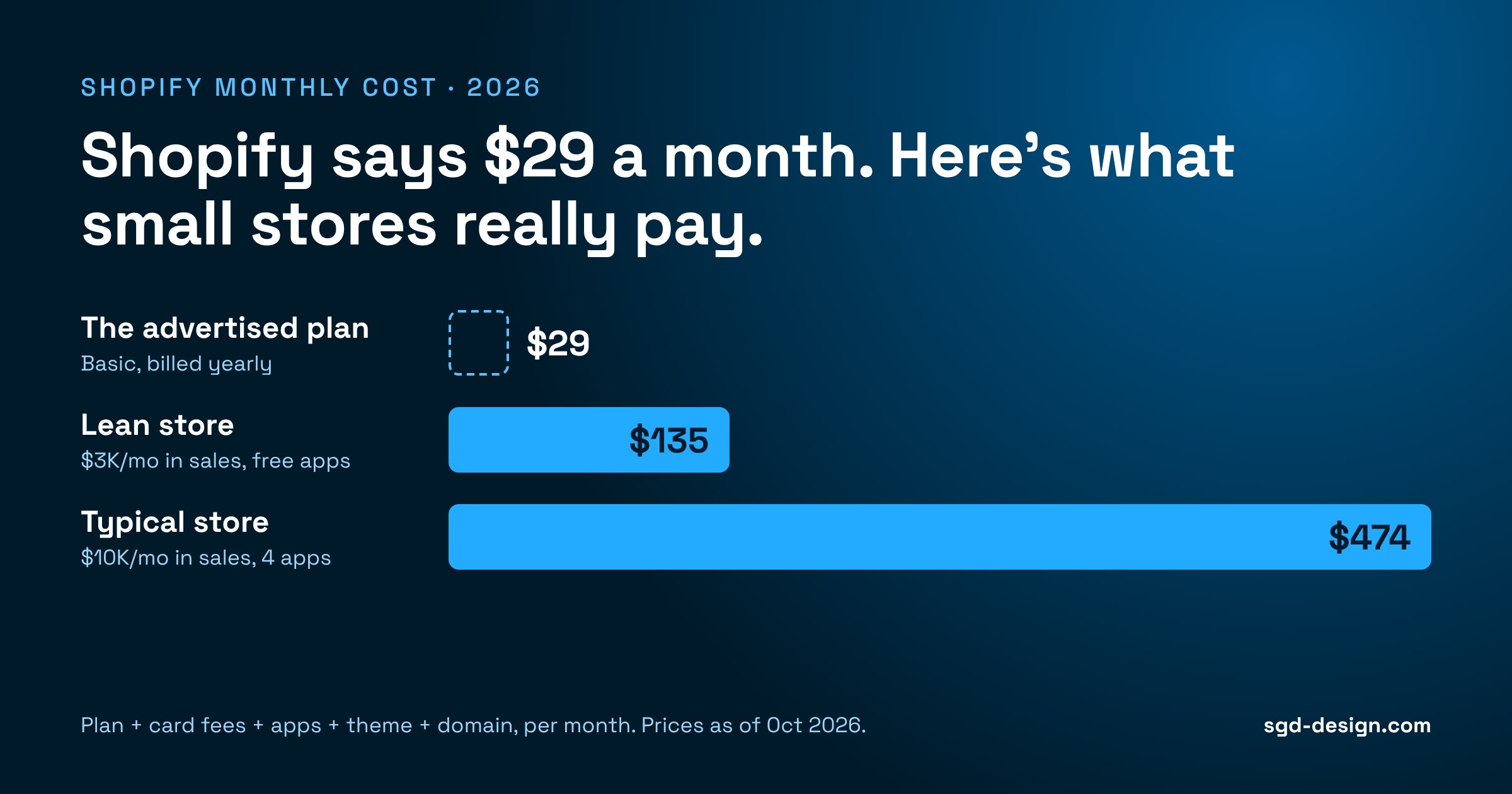
Shopify’s pricing page says $29 a month. Almost nobody’s real Shopify monthly cost is $29.
That isn’t a trick. The $29 is the plan, and the plan is only one of five lines on your bill. The others are card fees, apps, your theme and your domain, and for most small stores the card fees alone are bigger than the plan.
I set up and run Shopify stores for clients, and the question I get most after “which platform?” is “so what will this actually cost me?” If you’re still choosing a platform, start with WordPress vs Shopify vs Squarespace. This post is the arithmetic: two realistic small stores, added up line by line, with every price taken from the source.
The five lines in your Shopify monthly cost
- The plan. What you pay Shopify to run the store. Basic is $39 a month, or $29 a month billed yearly. Grow is $105 or $79, and Advanced is $399 or $299.
- Card fees. What Shopify keeps from each sale when a customer pays by card. On Basic it’s 2.9% of the sale plus 30¢ per order. Premium cards cost more (3.5% + 30¢ on Basic) and international cards add another 1%.
- Apps. Reviews, email marketing, Instagram feeds, page builders. Each one is a separate monthly subscription.
- Your theme. Free themes cost nothing. Premium themes are a one-time purchase, often a few hundred dollars.
- Your domain. A .com bought through Shopify costs around $16 a year.
Two smaller things are worth knowing before you start:
- Monthly vs yearly billing. Basic billed monthly costs $120 more over a year than billed yearly. Yearly billing is paid upfront, and plan fees are generally non-refundable, so only commit once you’re sure.
- The $1 trial isn’t your price. Shopify currently offers 3 days free, then $1 a month for 3 months. Budget for month four, not month one.
Example 1: a lean store
Say you sell $3,000 a month: 60 orders at a $50 average. You’re on Basic, billed yearly, using Shopify Payments, and you’re keeping the app list short.
| Line | Monthly | Source |
|---|---|---|
| Basic plan (billed yearly) | $29.00 | Shopify pricing |
| Card fees: 2.9% × $3,000 + 30¢ × 60 orders | $105.00 | Shopify pricing |
| Free theme | $0.00 | Shopify Theme Store |
| Judge.me reviews (Free plan) | $0.00 | Judge.me pricing |
| Shopify Messaging email (10,000 emails a month free) | $0.00 | Shopify Help Center |
| Instafeed (Free plan) | $0.00 | Shopify App Store |
| .com domain (about $16 a year) | $1.33 | Shopify |
| Total | $135.33 | about 4.5% of sales |
Notice where the money goes. The plan is $29, and the card fees are $105. For a small store, payment processing is usually the biggest line on the bill, and it grows with every sale.
Example 2: a typical store
Now say you sell $10,000 a month: 200 orders, on Basic billed monthly. This one runs the app stack I set up for most clients: Klaviyo for email, Judge.me for reviews, Instafeed for an Instagram feed and PageFly for landing pages, plus a premium theme.
| Line | Monthly | Source |
|---|---|---|
| Basic plan (billed monthly) | $39.00 | Shopify pricing |
| Card fees: 2.9% × $10,000 + 30¢ × 200 orders | $350.00 | Shopify pricing |
| Prestige theme ($400 one-time, spread over 2 years) | $16.67 | Shopify Theme Store |
| Klaviyo Email (251–500 profiles) | $20.00 | Capterra, Klaviyo pricing |
| Judge.me Awesome | $15.00 | Judge.me pricing |
| Instafeed Pro | $8.00 | Shopify App Store |
| PageFly Builder | $24.00 | PageFly pricing |
| .com domain | $1.33 | Shopify |
| Total | $474.00 |
The headline price was $39. The real bill is $474. That’s not a problem as long as you planned for it. It only becomes one when it shows up as a surprise.
These are illustrations built from current list prices, not a client’s actual bill. Your numbers will move with your order size, your card mix and the apps you pick.
Which apps are worth it at your size
I don’t think in terms of apps to cut. Every app in Example 2 is one I install for clients, and each one earns its fee for the right store. What decides it is what the business can afford and what you or your team will actually manage.
- Klaviyo is worth paying for once you’re running real automated emails, like an abandoned-cart reminder or a welcome series, and someone will look after them. If you’re sending a newsletter now and then, Shopify Messaging covers it: 10,000 emails a month are free, then $1 per 1,000. Klaviyo also has a free plan for up to 250 profiles and 500 sends a month.
- Judge.me I add from day one. Reviews sell, and moving thousands of reviews from one app to another later is a real job. The free plan is enough for most small stores. The Awesome plan ($15) adds the extras once you need them.
- Instafeed can stay on its free plan until Instagram is a real sales channel for you. Pro is $8 a month when it is.
- PageFly earns its $24 when someone on your team will build landing pages themselves, like a launch page or a holiday sale. If nobody will, your theme’s built-in sections do the job.
Here’s Example 2 trimmed to fit a store that isn’t ready for all four: Shopify Messaging instead of Klaviyo, Instafeed on its free plan and no PageFly. That saves $52, bringing the bill to $422 a month, or $412 on yearly billing.
One catch when you remove an app: Shopify says some apps add code to your theme that isn’t removed automatically when you uninstall them, and uninstalling doesn’t refund the current billing cycle. Check the app’s cleanup steps before you remove it, and look over your theme afterwards.
When the cheap plan stops being cheap
Upgrading from Basic to Grow lowers your online card rate from 2.9% to 2.7%. On yearly billing, Grow costs $50 a month more than Basic, and saving 0.2% on card sales only covers $50 once you sell about $25,000 a month online. On monthly billing the gap is $66, so the break-even is about $33,000. Below that, Basic is cheaper. Above it, Grow pays for itself.
The same math says Advanced only beats Grow at about $110,000 a month in online sales. Most small stores never get near it.
The payment-provider trap
If you use a payment provider other than Shopify Payments, Shopify charges its own transaction fee on top: 2% on Basic, 1% on Grow and 0.6% on Advanced. That’s in addition to whatever your provider charges. On $10,000 a month in sales, the 2% is $200 a month, more than the cost of upgrading to Grow. If you need a different provider, factor that fee in before you pick a plan.
What I’d do
- Budget for the whole bill, not the plan. For a small store, card fees plus apps usually add up to more than the plan.
- Add apps when you need them, not all at once. Start with reviews. Add email automation and page builders when someone will use them.
- Pick yearly billing once you’re sure about Shopify. It saves $120 a year on Basic.
- Re-check your plan as you grow. Somewhere around $25,000 a month in online sales, Grow starts paying for itself.
- Keep the store in your name. When I set up a store, it runs on accounts the client owns. I work through Shopify’s collaborator access, and I document every change I make and which account it’s under, with credentials kept in a password manager, never in notes or emails.
If you’d like a second opinion on your own store, send me your last Shopify bill. I’ll go through it line by line and tell you what I’d keep, what I’d change and when an upgrade makes sense. You can also see how I set up stores on my Shopify services page.
Sources
- Shopify, Pricing, accessed October 25, 2026.
- Shopify Help Center, Third-party transaction fees, accessed October 24, 2026.
- Shopify Help Center, Pricing overview, accessed October 24, 2026.
- Shopify Help Center, Shopify Messaging email pricing, accessed October 25, 2026.
- Shopify Help Center, Uninstalling apps, accessed October 25, 2026.
- Shopify, How much does a Shopify domain cost?, May 22, 2026.
- Shopify Theme Store, Prestige, accessed October 25, 2026.
- Judge.me, Pricing, accessed October 25, 2026.
- Shopify App Store, Instafeed by Mintt Studio, accessed October 25, 2026.
- PageFly, Pricing, accessed October 25, 2026.
- Klaviyo Help Center, Understanding how free and paid plans differ, updated October 20, 2026.
- Capterra, Klaviyo pricing, accessed October 25, 2026.